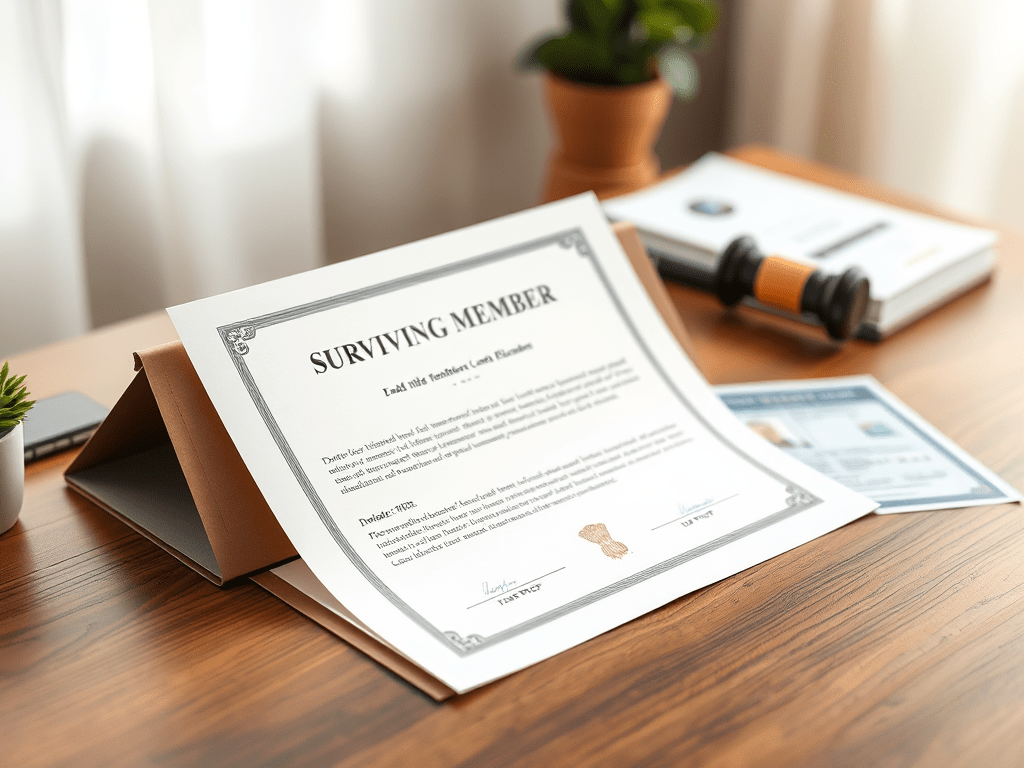
When a family member passes away, their legal heirs may need to handle various financial and property matters. One important document that often comes into play in such situations is the Surviving Member Certificate. This certificate serves as legal proof of the surviving family members of the deceased and is frequently required to transfer assets, claim insurance and settle property matters.
In this blog, we will discuss in detail what a Surviving Member Certificate is, why it is needed and how to apply for a Surviving Member Certificate in Delhi.
What is a Surviving Member Certificate?
A Surviving Member Certificate is an official document issued by the revenue department or the local municipal authorities. It lists the legal heirs or surviving members of a deceased individual. This certificate is not the same as a legal heir certificate but is often used as supporting documentation for succession-related matters.
Importance of a Surviving Member Certificate
A Surviving Member Certificate is vital in various scenarios:
- For transferring ownership of property, land or houses.
- To claim pensions, gratuity or provident fund.
- For insurance settlements.
- To transfer bank balances, deposits or investments.
- To avoid legal disputes between family members over inheritance.
Having this certificate ensures a smooth legal process when handling the estate of the deceased.
Procedure to Apply for a Surviving Member Certificate Delhi
Applying for a Surviving Member Certificate Delhi involves several steps:
- Application Submission – The application must be submitted to the Sub-Divisional Magistrate (SDM) office in the area of the deceased’s residence.
- Required Documents – Applicants must provide essential documents such as:
- Death certificate of the deceased
- Identity proof of surviving family members
- Address proof of the applicant
- Family details affidavit
- Death certificate of the deceased
- Verification – After submission, the authorities verify the details through local inquiries and records.
- Certificate Issuance – Once verified, the SDM issues the certificate listing all surviving members of the deceased’s family.
The process typically takes a few weeks, depending on the workload and document verification.
Documents Required for Surviving Member Certificate Delhi
To apply for a Surviving Member Certificate Delhi, you generally need:
- Duly filled application form
- Aadhaar card, voter ID or any government ID proof
- Proof of residence (ration card, utility bill, etc.)
- Death certificate of the deceased
- Self-declaration or affidavit regarding family details
- Passport-size photographs of the applicant
Difference Between Legal Heir Certificate and Surviving Member Certificate
Many people confuse the two, but there is a distinction:
- Legal Heir Certificate – Specifies the legal heirs who are entitled to inherit the property.
- Surviving Member Certificate – Simply lists all surviving members of the family without addressing inheritance rights.
In Delhi, depending on the situation, authorities may ask for either or both.
Final Thoughts
A Surviving Member Certificate is an essential document to establish family details after the death of a person. For residents of Delhi, applying for a Surviving Member Certificate Delhi through the SDM office is a straightforward process if all documents are in place.
If you are facing succession or inheritance matters, obtaining this certificate at the earliest will help you avoid unnecessary delays and legal complications.
FAQs on Surviving Member Certificate and Surviving Member Certificate Delhi
1. What is a Surviving Member Certificate?
A Surviving Member Certificate is a government-issued document that lists all the surviving legal family members of a deceased person. It is often required for succession, property transfer and financial claims.
2. Why is a Surviving Member Certificate important?
It is important because it helps establish the family composition of the deceased. This certificate is commonly needed for property transfers, insurance claims, pension settlements and other inheritance-related matters.
3. How can I apply for a Surviving Member Certificate in Delhi?
In Delhi, you can apply for a Surviving Member Certificate at the Sub-Divisional Magistrate (SDM) office of the area where the deceased last resided. You must submit an application form along with supporting documents such as a death certificate, ID proof and address proof.
4. What documents are required for a Surviving Member Certificate in Delhi?
The main documents required include:
- Death certificate of the deceased
- Identity proof of surviving family members
- Address proof of the applicant
- Family details affidavit
- Passport-size photographs
5. How long does it take to get a Surviving Member Certificate in Delhi?
It usually takes 2–3 weeks to receive a Surviving Member Certificate in Delhi, depending on document verification and the workload of the SDM office.
6. What is the difference between a Surviving Member Certificate and a Legal Heir Certificate?
A Legal Heir Certificate identifies the rightful heirs who can inherit the deceased’s assets, whereas a Surviving Member Certificate only lists the living family members without addressing inheritance rights.
7. Can I apply online for a Surviving Member Certificate in Delhi?
Yes, in Delhi, you can apply online through the Delhi e-District portal. After online submission, you may still need to visit the SDM office for verification and document submission.
8. Who issues the Surviving Member Certificate in Delhi?
The Surviving Member Certificate in Delhi is issued by the Sub-Divisional Magistrate (SDM) of the concerned area after verification of the submitted documents.
9. Is a Surviving Member Certificate mandatory for property transfer?
Yes, in most cases, property registration authorities require a Surviving Member Certificate to confirm the family members of the deceased before allowing property transfer.
10. What is the validity of a Surviving Member Certificate in Delhi?
A Surviving Member Certificate does not have an expiry date. It remains valid unless there are changes in the surviving family structure, such as the death of another member.
 Your Blog Festival
Leave a comment